
 (EN)
(EN)
Not Just Chips: AI Investing Beyond Semiconductors
Written by The Inspired Investor Team
Published on July 10, 2026
minute read
Share:


The artificial intelligence boom has created a new generation of stock-market stars, from the chipmakers powering the technology to the software companies putting it in people’s hands. But just out of the spotlight, there’s a whole supporting cast across many sectors building and powering the physical infrastructure that AI depends on – and these companies could also benefit from the surging popularity of AI.
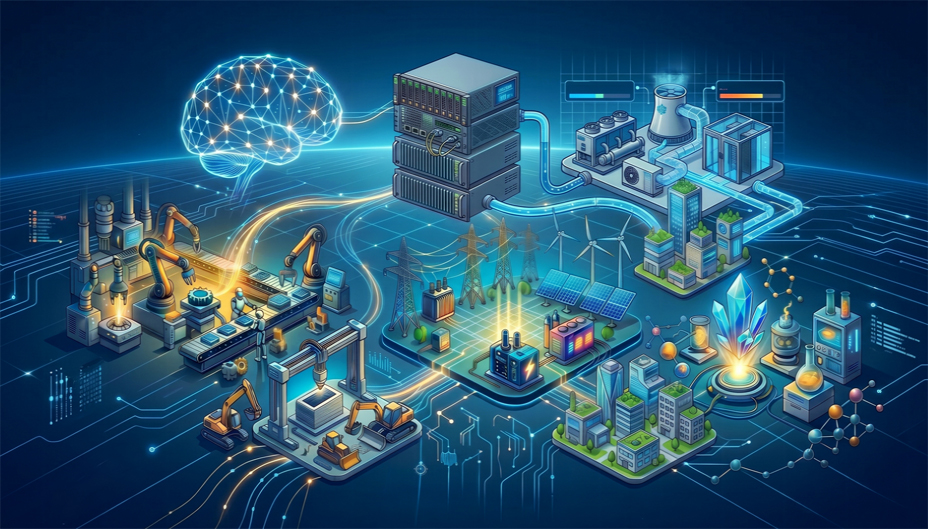
In 2026 alone, the world’s biggest publicly owned data centre operators are expected to spend nearly US$750 billion on capital projects. This is part of the US$6.7 trillion in global investment expected to keep pace with demand for compute power.1 It’s one of the largest infrastructure buildouts in modern business, anticipated to create opportunity in sectors far beyond technology – including power generation, cooling and HVAC systems, electrical equipment, construction expertise and specialized real estate.
Canada’s own data centre footprint is relatively modest but expected to grow exponentially in the next few years. Much of the buildout will be dedicated to hyperscale sites to serve AI.
Ottawa is working to support that growth on a broader scale. In June, the federal government unveiled a multibillion-dollar national strategy aimed at expanding sovereign AI infrastructure, creating up to 90,000 jobs and increasing the share of Canadian businesses using the technology to 60 per cent by 2034 (it’s only about 12 per cent today).2
The shift has hardly gone unnoticed. Ivan Medovikov, Associate Professor of Economics at Brock University, sees a parallel with the introduction of early internet, when companies like Netscape and Yahoo! captured the first wave of attention but much of the lasting value came later, from businesses that found new ways to put the technology to work.
“The majority of the value around the internet was created by all the others,” he says.
The same pattern may be forming in AI. David Tron, a technology-focused Senior Portfolio Manager at RBC Global Asset Management Inc., says investors have been watching many of the direct beneficiaries of the AI boom for some time. The more interesting question now may be what comes next.
“We’re looking even further down the line, at the second or third derivative of that opportunity,” he says.
The challenge is knowing which parts of the boom have staying power, which are getting overhyped and what to keep in mind before putting money into the sector, he adds.
Key sectors to watch
Before an AI model can answer a single prompt, a lot has to happen in the background. The technology depends on vast data centre networks, including super-sized “hyperscale” facilities, one of which spans hundreds of thousands of square metres, built to house thousands of servers.3 Running these sites requires kilometres of fibre-optic cables, sophisticated networking equipment, enormous power loads, advanced cooling systems (increasingly, liquid cooling for the hottest AI chips4), backup systems, and physical and cybersecurity protection.
This kind of massive expansion creates opportunity for five AI-adjacent sectors:
- Power generation and utilities sit at the centre of the electricity challenge.
- Electrical equipment and grid infrastructure help move and manage that power.
- Cooling and HVAC systems keep servers stable.
- Construction and engineering firms handle data centre construction.
- Data centre real estate investment trusts, or REITs, bring industrial real estate into the AI story by owning and leasing the specialized facilities that house servers.
For Medovikov, investment interest in these AI-adjacent companies is grounded in a real economic shift. Power producers are the clearest case, with the spike in demand already translating into large capital commitments.
The International Energy Agency estimates data centres used about 415 terawatt-hours in 2024, and it projects that will more than double to around 945 terawatt-hours by 2030.5 To put that into perspective, that’s close to Japan’s annual energy consumption.6
Power producers may or may not use a lot of AI themselves, says Medovikov. “But they’re still going to benefit from it, just because there is more demand for power.”
A recent example of a power company benefiting from the AI boom is Greenlight Electricity Centre in Alberta, a $4.6-billion, 932-megawatt project approved by Pembina Pipeline and its partners to supply a major data centre under a long-term energy agreement.7
For an investor, though, a real economic tailwind and a good stock are not the same thing. Tron says many of the AI data centre stocks tied to the spending boom have already drawn plenty of attention. Some already trade at valuations that reflect years of expected growth, while others have seen earnings forecasts revised to be higher as the market tries to account for the scale of the buildout.
A lot of the good news, Tron says, is already priced in.
Which companies benefit from AI besides tech companies?
Once the most direct data-centre beneficiaries are well understood, the search for investment opportunities moves farther along the AI supply chain. Some of them are still closely linked to AI infrastructure. Others support what companies can do once that infrastructure is in place.
Semiconductor manufacturing equipment
For Tron, the next layer of investment opportunity starts with semiconductor manufacturing equipment. AI data centres depend on advanced chips, including graphics processing units (GPUs) and other accelerators, to train and run large models.8 If demand for compute power keeps rising, the world will need more capacity to manufacture the semiconductors that make it possible. That spending is already climbing. SEMI, the semiconductor industry’s trade association, expects global spending on chip-factory equipment to reach US$151 billion by 2027.9 That could create opportunities for companies that sell the highly specialized tools used inside semiconductor manufacturing facilities.
“There is a small group of companies and stocks, some of which are American, one of which is European, and some of which are Japanese, that sell equipment to semiconductor factories,” says Tron. “This equipment is incredibly difficult to build, and there are only a few companies that can supply it.”
The companies include Taiwan Semiconductor Manufacturing Company (TSMC), the industry’s dominant player with more than 70 per cent market share,10 as well as Intel and Elon Musk’s Terafab.
More broadly, Tron says, he looks for suppliers with advantages that can last, including “durable market share, pricing power, staying power.” One example is the group of companies helping major tech firms develop custom chips, especially as those customers look for more affordable alternatives to standard processors.
If a company thinks one company’s chips are too pricey, says Tron, they can work with a supplier to develop custom alternatives that could be “notably cheaper.”
The opportunity beyond infrastructure
Then there are the less obvious examples. Some analysts believe that if AI helps companies cut costs through efficiency gains and smaller workforces, many businesses will redirect at least some of those savings into sales and marketing as they compete more aggressively for customers. That could lift industries well outside the AI infrastructure boom. “There are some digital advertising businesses that we believe are going to be immense beneficiaries of that,” notes Tron.
Medovikov sees a similar widening effect as companies across sectors spend time and money figuring out how to put AI to practical use. “There’s going to be a huge cohort of businesses that will spend a lot of time and money, and frankly, create a lot of value around taking that technology and actually doing useful things with it.”
Reward vs. risk: What investors should consider
Of course, with opportunity there is also risk – especially in a market moving this quickly.
Correlation with AI adoption cycles
For Medovikov, one of the biggest questions is whether today’s infrastructure plans will still match the technology’s needs five years – or even one year – from now. Demand for AI computing may keep rising, but the systems themselves are also rapidly improving.
“Look at computing,” he says. “The first mainframes took up the space of a school gym, and now the phone in your pocket can vastly outperform that.”
If AI follows a similar path, the footprint of the build-out could change. Models may become faster, smaller and cheaper to run, reducing how much hardware, memory, energy or data centre space companies need. The boom may continue, but its size and scope could shift dramatically.
Tron sees a related risk in parts of the supply chain where scarcity has created pricing power. Commodity suppliers can benefit when demand is strong and supply is tight, but the advantage may not last if the biggest AI buyers find ways to reduce their dependence on costly components.
“There’s no doubt in my mind, all of these spenders are deploying the smartest engineers on that exact problem right now,” he says.
Public and regulatory resistance
There is also a possibility that the build-out runs into public or regulatory resistance. Data centres are already raising concerns around high electricity and water use, emissions, noise and grid access.11 A recent Angus Reid Institute survey found 68 per cent of Canadians would oppose a large AI data centre being built within a few blocks of their home, and the same share said governments should heavily regulate AI and technology companies even if that slows development.12
“I don’t think we really know what the next set of guardrails needs to be until we experience some pretty scary adverse events,” says Medovikov.
The sheer speed of change is another big reason why it’s difficult to assess AI-related investments. The technology is changing so quickly that even people close to the industry are careful about making predictions.
“It is very complicated,” says Tron. “I don’t know what this technology looks like three years from now. No one does. The people, even the people building it, don’t know what it looks like.”
What to look for
For investors considering opportunities, a useful test is to consider whether AI is strengthening the business case or carrying it. Energy is a good example. Data centres add serious demand – but they’re just the latest addition to a long list. Population growth, an aging grid and the shift away from fossil fuels toward electrification were already increasing the global appetite for power long before AI came along. So even if AI stalled tomorrow, the case for energy would still stand on its own, says Medovikov. “I’d like to build a thesis, but I don’t want AI to be a linchpin of the thesis.”
Still, count him among those who believe AI is grounded in something real. “Is there hype around it? Sure,” he says. “But there’s usually hype around genuinely exciting and interesting stuff.”
- McKinsey & Company, “The cost of compute: A $7 trillion race to scale data centers”, April 2025
- Government of Canada, “Canada’s National Artificial Intelligence Strategy: AI for All”, accessed July 2026
- IBM, “What is a hyperscale data center?”, accessed July 2026
- IEEE Spectrum, “Next-gen AI needs liquid cooling”, October 2025
- IEA, “AI is set to drive surging electricity demand from data centres while offering the potential to transform how the energy sector works”, April 2025
- Visual Capitalist, “Which Countries Use the Most Electricity?”, May 2026
- CBC, “Pembina, partners go ahead with gas plant for data centre north of Edmonton”, July 2026
- IBM, “What is an AI chip?”, accessed July 2026
- SEMI, “Strong AI and Advanced Node Demand to Propel Semiconductor Equipment Investments Beyond $150 Billion for the First Time”, April 2026
- Morningstar, “Taiwan Semiconductor Manufacturing Co Ltd ADR TSM”, accessed July 2026
- World Resources Institute, “From Energy Use to Air Quality, the Many Ways Data Centers Affect US Communities”, February 2026
- Angus Reid Institute, “Canadians call for heavy AI regulation, but three-quarters doubt any government can keep up with the technology”, June 2026
RBC Direct Investing Inc. and Royal Bank of Canada are separate corporate entities which are affiliated. RBC Direct Investing Inc. is a wholly owned subsidiary of Royal Bank of Canada and is a Member of the Canadian Investment Regulatory Organization and the Canadian Investor Protection Fund. Royal Bank of Canada and certain of its issuers are related to RBC Direct Investing Inc. RBC Direct Investing Inc. does not provide investment advice or recommendations regarding the purchase or sale of any securities. Investors are responsible for their own investment decisions. RBC Direct Investing is a business name used by RBC Direct Investing Inc. ® / ™ Trademark(s) of Royal Bank of Canada. RBC and Royal Bank are registered trademarks of Royal Bank of Canada. Used under licence.
© Royal Bank of Canada 2026.
Any information, opinions or views provided in this document, including hyperlinks to the RBC Direct Investing Inc. website or the websites of its affiliates or third parties, are for your general information only, and are not intended to provide legal, investment, financial, accounting, tax or other professional advice. While information presented is believed to be factual and current, its accuracy is not guaranteed and it should not be regarded as a complete analysis of the subjects discussed. All expressions of opinion reflect the judgment of the author(s) as of the date of publication and are subject to change. No endorsement of any third parties or their advice, opinions, information, products or services is expressly given or implied by RBC Direct Investing Inc. or its affiliates. You should consult with your advisor before taking any action based upon the information contained in this document.
Furthermore, the products, services and securities referred to in this publication are only available in Canada and other jurisdictions where they may be legally offered for sale. Information available on the RBC Direct Investing website is intended for access by residents of Canada only, and should not be accessed from any jurisdiction outside Canada.
Explore More

Signal vs Noise: What Portfolio Advisors Actually Watch For
Senior RBC portfolio advisor Todd Graham explains key metrics and indicators that can help investors through volatile times
minute read

10 Money Books to Read This Summer
We’ve rounded up ten money-related books to help level up your investments
minute read

How to Spot (and Avoid) Lifestyle Creep
As income rises, spending tends to rise, too. Here’s how to get a handle on lifestyle creep
minute read
Inspired Investor brings you personal stories, timely information and expert insights to empower your investment decisions. Visit About Us to find out more.