
 (EN)

The Big Question: How Can I Participate in an IPO?
Written by The Inspired Investor Team

Published on November 18, 2026
minute read
Share:


When a company goes from private to public, there are different ways for investors to participate and they take place in the primary and secondary markets. Let’s break them down.
Understanding the difference between primary and secondary markets
Buying newly issued shares through an initial public offering (IPO) is done in the primary market. For most investors, their first opportunity to buy and sell the shares will be when the shares start trading on the secondary market, which is made up of public exchanges such as the Toronto Stock Exchange, the New York Stock Exchange or the Nasdaq Stock Market.
Primary market: The primary market allows companies to raise capital by selling new shares to investors, typically through underwriters. The company and underwriters work together to set a price and set terms, and the underwriters help to market and distribute the securities to investors through a syndicate of broker-dealers. An IPO can also include shares sold by existing shareholders, such as venture capitalists, angel investors, employees and executives, who receive the proceeds from those sales.
The company and underwriters also decide the number of shares offered, as well as how many shares will go to larger institutional investors and to retail investors. The goal is to set a price that balances raising capital with attracting investor demand. There are many factors that play a role in the allocation of shares, and this is decided by the company and underwriters. Typically, more shares are allocated to institutional investors, as in most cases they can commit larger amounts of money and generate longer-term demand. Sometimes, an IPO is considered oversubscribed – meaning there aren’t enough shares to meet demand.
For institutional investors, companies may impose lock-up periods, which restricts them from selling shares for a certain period after the company goes public. Lock-up periods generally don’t apply to retail investors who are allocated IPO shares.
Secondary market: The secondary market is where investors buy and sell shares from each other on a stock exchange, rather than directly from a company. Prices fluctuate on public markets, so you could be buying higher or lower than the initial price set by the company and its underwriters.
In Short:
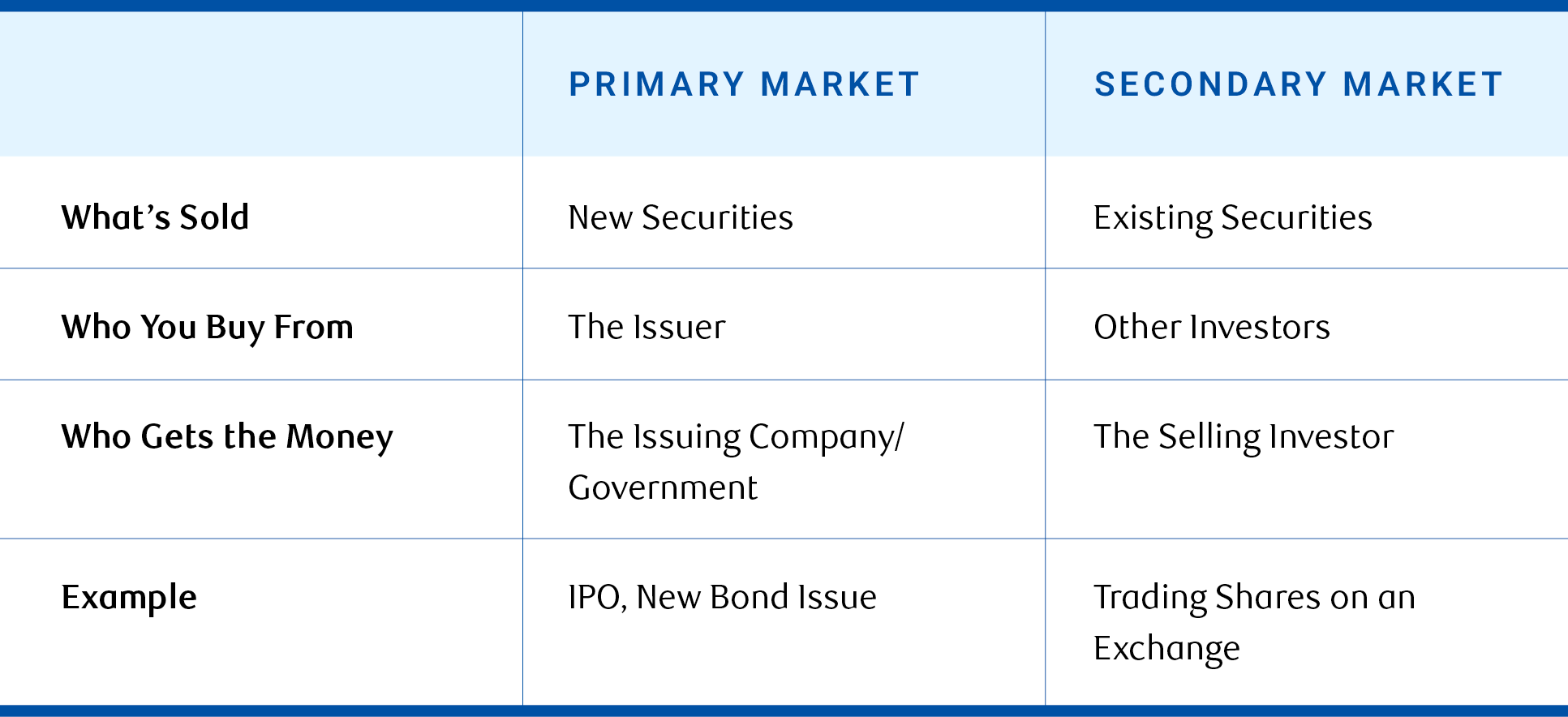
The two markets work together: the primary market lets issuers raise capital, and the secondary market gives investors liquidity - the ability to sell their holdings when they want. Without a healthy secondary market, investors would be far less willing to buy in the primary market, since they'd have no easy exit.
How to get shares of an IPO
If you’re hoping to buy shares through an IPO, you may be able to submit an expression of interest through your brokerage, provided it offers access to that offering. RBC Direct Investing, for example, offers access to select IPOs. There’s no guarantee you’ll get all or any of the shares you request, though. In some cases, IPOs become oversubscribed, and, as mentioned above, the distribution of shares between retail and institutional investors is determined by the company and underwriters. Of course, investors can also try to buy shares on the secondary market once public trading begins.
If you’re allocated shares through the IPO, you’ll pay the offering price set by the company and underwriters before public trading begins rather than the market price of the stock after it’s listed.
Unless stipulated otherwise in brokerage policies or restrictions, you can sell those shares once trading begins on the secondary markets. Always review the prospectus and other offering documents, as well as your brokerage’s terms for details.
Whichever way you buy, remember that IPO's can be volatile, and shares may trade below their offering price after public trading begins. But IPOs can also offer investors an opportunity to get in early on a company’s next chapter and, possibly, benefit from its long-term growth.
RBC Direct Investing Inc. and Royal Bank of Canada are separate corporate entities which are affiliated. RBC Direct Investing Inc. is a wholly owned subsidiary of Royal Bank of Canada and is a Member of the Canadian Investment Regulatory Organization and the Canadian Investor Protection Fund. Royal Bank of Canada and certain of its issuers are related to RBC Direct Investing Inc. RBC Direct Investing Inc. does not provide investment advice or recommendations regarding the purchase or sale of any securities. Investors are responsible for their own investment decisions. RBC Direct Investing is a business name used by RBC Direct Investing Inc. ® / ™ Trademark(s) of Royal Bank of Canada. RBC and Royal Bank are registered trademarks of Royal Bank of Canada. Used under licence.
© Royal Bank of Canada 2026.
Any information, opinions or views provided in this document, including hyperlinks to the RBC Direct Investing Inc. website or the websites of its affiliates or third parties, are for your general information only, and are not intended to provide legal, investment, financial, accounting, tax or other professional advice. While information presented is believed to be factual and current, its accuracy is not guaranteed and it should not be regarded as a complete analysis of the subjects discussed. All expressions of opinion reflect the judgment of the author(s) as of the date of publication and are subject to change. No endorsement of any third parties or their advice, opinions, information, products or services is expressly given or implied by RBC Direct Investing Inc. or its affiliates. You should consult with your advisor before taking any action based upon the information contained in this document.
Furthermore, the products, services and securities referred to in this publication are only available in Canada and other jurisdictions where they may be legally offered for sale. Information available on the RBC Direct Investing website is intended for access by residents of Canada only, and should not be accessed from any jurisdiction outside Canada.
Explore More

The Ultimate Guide to Maximizing Your FHSA
Here’s how the FHSA works, plus six strategies to make the most of the account
minute read

Split Share Funds: The Fund You've Probably Never Heard Of
Here’s how split shares work, why investors might consider them and what to know about the risks
minute read

How To Spot a Bank Impersonation Scam and What To Do Next
We break down the warning signs of these scams and what to do next
minute read
Inspired Investor brings you personal stories, timely information and expert insights to empower your investment decisions. Visit About Us to find out more.