
 (EN)
(EN)
3 Things We’re Watching This Week: Canada-U.S. Summit, GLP-1s, Canadian Energy
Written by The Inspired Investor Team
Published on June 29, 2026
minute read
Share:


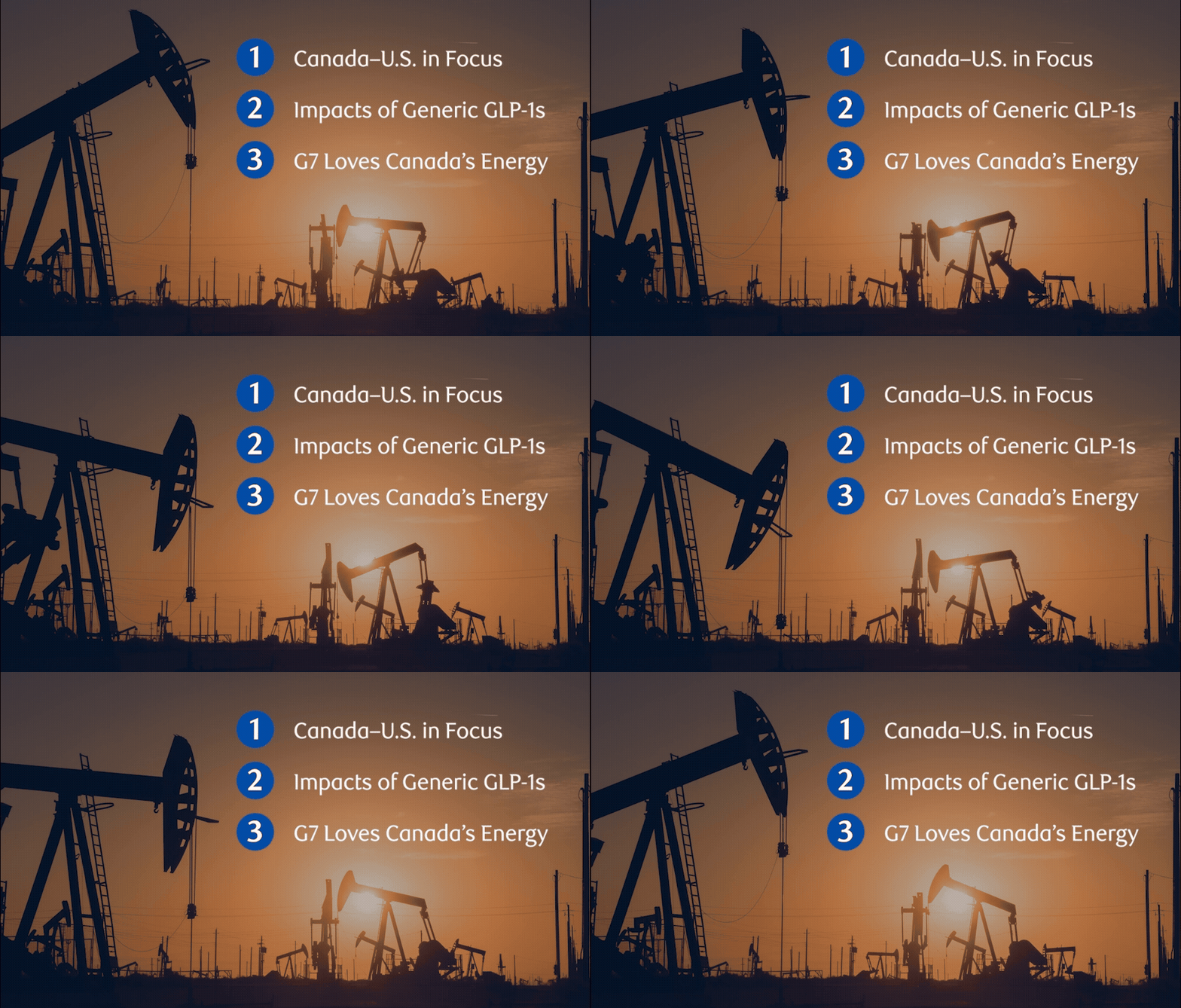
3 Things We’re Watching:
- Lessons from the U.S.–Canada Summit
The recent Canada–U.S. Summit, hosted by RBC and the Eurasia Group, heard that relationship between the two countries may be warming,1 but with an ongoing trade dispute, a push to build stronger supply chains and a race to keep up on AI, don’t expect a return to business as usual any time soon.
More than 500 business, government and policy leaders gathered in Toronto alongside some of the most influential voices in trade, investing and geopolitics to discuss the challenges and opportunities facing one of the world’s most prosperous relationships.2
There’s a lot at stake. Canada and the U.S. do $1.3 trillion in trade each year,3 which supports millions of jobs and helps to keep goods, people and investments flowing across the border.
But the relationship between them has clearly shifted.
Both countries are becoming more hands-on in their economies, using spending, tariffs, procurement and regulation to strengthen key domestic industries and reduce reliance on fragile supply chains. Daleep Singh, vice chair and chief global economist with asset manager PGIM, described the current situation as a world of “fiscal dominance.”4
And then there’s AI. Data centres are becoming critical infrastructure for the AI economy, but as Prologis CEO Hamid Moghadam noted, companies build where it is easiest to invest – and Canada is not high on the list. Fewer than one in five Canadian companies have adopted AI. A new national AI strategy aims to boost awareness, skills and business adoption; at the same time, growing public concerns are raising questions about how the technology should be governed, and Canada and the U.S. are taking different approaches.
The bottom line: The Canada–U.S. relationship is changing. Former U.S. trade representative Robert Lighthizer said tariffs will likely be here for a generation. The panellists discussed how governments on both sides are playing a bigger role in the economy, and that could mean more government debt, higher inflation and greater political risk. At the same time, sectors such as energy, critical minerals and food are being made increasingly more important. Canada, meanwhile, has some catching up to do on AI. But leaders also see room for optimism. The consensus was to “diversify, not decouple” – that is, build new bridges without burning the old ones.
- The rise of generic semaglutide
The medication behind the weight-loss boom just got a lot cheaper in Canada. Canada recently became the first G7 country to approve a generic version of semaglutide, the active ingredient in popular GLP-1 drugs such as Ozempic and Wegovy.5 A second generic followed days later,6 and others are under review.
For consumers, it’s good news: generic drugs are 45 to 90 per cent cheaper than brand-name versions,7 and prices are expected to fall even further as more competitors enter the market.8 The savings could also ease pressure on healthcare budgets. Spending on Ozempic has surged from about $13 million a year to more than $800 million, making it the fastest-growing drug expense for public drug plans, according to Canadian Institute for Health data.9 The plans generally cover the drug for type 2 diabetes, and people taking it for weight loss often pay out of pocket.10
The effects of increased GLP-1 use are already showing up in the food industry. Studies show that households with a person taking GLP-1 cut grocery spending by an average of 5.3 per cent within the first six months,11 with the decline even greater (eight per cent) among higher-income households. Meanwhile, spending at fast-food restaurants and coffee shops also decreased by about eight per cent. J.P. Morgan estimates the medications could reduce annual food and beverage sales by up to $78 billion by 2030.12
The bottom line: Morgan Stanley expects the global market for obesity and diabetes medications to reach nearly $270 billion by 2035,13 more than double today’s level. And as the drugs move further into the mainstream, attention is shifting to their wider economic impact. Don’t be surprised to see “GLP-1 friendly” stamped on food packages and smaller-portion, fibre-rich products on the grocery shelves as food makers adjust to the new reality.14 Meanwhile, gym memberships and clothing sales are rising,15,16 and alcohol sales are declining17 – all potentially as a result of the medication. They may have started as a healthcare breakthrough, but GLP-1s, generic or branded, are fast becoming an important business story – and something investors might want to know.
- Canada’s energy wins G7 endorsement
The 2026 Iran war that choked off the Strait of Hormuz – the narrow waterway that had, until earlier this year,18 carried about a fifth of the world’s oil19 – has renewed global concerns around energy security. At the G7 summit in France on June 17, the leaders pledged to diversify supply routes away from the strait and singled out Canada, the world’s fourth-largest oil producer, by name, welcoming its potential to deliver “significant additional capacity”20 to global markets over the coming years.
Prime Minister Mark Carney has been pitching Canada as both an energy superpower and a dependable partner, pointing to new LNG terminals,21 the expanded Trans Mountain pipeline22 (now running at full capacity)23 and the possibility of two more pipelines from Western Canada.24 He also announced 13 new critical minerals partnerships with countries including Germany, France, Italy, Japan and Denmark. Ottawa says the deals could unlock more than $5 billion in investment.25
“It’s quite substantial and it’s important to our European partners. It’s important to our Asian partners,” Carney said about Canada’s energy capacity. “It was raised with me on a number of bilaterals, as well.”26
The bottom line: The opportunity is real, but don’t expect big changes to come quickly as Canada can’t replace the Gulf supply overnight.27 Most of Canada’s crude still heads south to the U.S., and limited room in the current system leaves few quick options for moving more oil. But some economists estimate that expanding export capacity by a third could add more than $31 billion a year to the Canadian economy28 – a 1.1-per cent increase in real GDP. A rare G7 namecheck at least suggests Canada has a much larger role to play in global energy security in the years ahead.
- RBC Thought Leadership, “Diversifying, not decoupling: The new U.S.-Canada nexus”, June 2026
- Government of Canada, “Doing business in the United States”, June 2026
- BNN Bloomberg, “Head of Canada’s top bank says U.S. trade deal too crucial to ‘cancel’”, June 2026
- RBC Thought Leadership, “Diversifying, not decoupling: The new U.S.-Canada nexus”, June 2026
- Government of Canada, “Canada becomes the first G7 country to approve a generic version of semaglutide”, April 2026
- Government of Canada, “Canada approves second generic semaglutide, the first G7 country to do so”, May 2026
- Government of Canada, “Canada becomes the first G7 country to approve a generic version of semaglutide”, April 2026
- CBC, “Generic Ozempic is now about $100 a month across the country. Canadians are taking note”, May 2026
- Canadian Institute for Health Information, “Ozempic: Boon for Diabetes Patients, Burden for the Health System?”, March 2026
- Canadian Medical Association, “Can you get GLP 1 drugs in Canada?” accessed June 2026
- Sage Journals, “The No-Hunger Games: How GLP-1 Medication Adoption Is Changing Consumer Food Demand”, December 2025
- JP Morgan, “How demand for (and supply of) weight loss drugs is playing out in 2026”, February 2026
- Morgan Stanley, “Obesity Drugs Are Scaling Fast”, April 2026
- CNBC, “GLP-1 drugs are changing how Americans eat. Food companies are racing to catch up”, March 2026
- Athletech News, “GLP-1s Are Boosting Gym Memberships, Data Shows”, May 2026
- EMARKETER, “GLP-1 boom could add $13 billion annually to apparel sales”, March 2026
- Morgan Stanley, “OPPORTUNITY NOW: Assessing the Next Order Effects of Increasing GLP-1 Use”, September 2025
- New York Times, “Iran War Timeline: Key Moments and Attacks”, June 2026
- U.S. Energy Information Administration, “World oil transit Chokepoints”, March 2026
- G7 France, “G7 leaders' statement on geopolitical issues.”, June 2026
- Calgary Herald, “Varcoe: Finally, something B.C. and Alberta can agree on – two big LNG projects await green light”, June 2026
- Global News, “Canada’s energy supply ‘potential’ gets G7 backing in push for global pivot”, June 2026
- Reuters, “Trans Mountain pipeline in Canada hits full capacity two years after upgrade”, June 2026
- CBC, “G7 backs Canada as major global energy supplier to lessen reliance on Strait of Hormuz”, June 2026
- Prime Minister of Canada, “Prime Minister Carney secures new partnerships in defence and critical minerals at the 2026 G7 Leaders’ Summit”, June 2026
- CBC, “G7 backs Canada as major global energy supplier to lessen reliance on Strait of Hormuz”, June 2026
- BOE Report, “Canada oil and gas profits to surge on Iran war, but firms hold off new investment”, April 2026
- Financial Times, “Canada’s oil producers in line for C$90bn windfall from Iran war”, March 2026
RBC Direct Investing Inc. and Royal Bank of Canada are separate corporate entities which are affiliated. RBC Direct Investing Inc. is a wholly owned subsidiary of Royal Bank of Canada and is a Member of the Canadian Investment Regulatory Organization and the Canadian Investor Protection Fund. Royal Bank of Canada and certain of its issuers are related to RBC Direct Investing Inc. RBC Direct Investing Inc. does not provide investment advice or recommendations regarding the purchase or sale of any securities. Investors are responsible for their own investment decisions. RBC Direct Investing is a business name used by RBC Direct Investing Inc. ® / ™ Trademark(s) of Royal Bank of Canada. RBC and Royal Bank are registered trademarks of Royal Bank of Canada. Used under licence.
© Royal Bank of Canada 2026.
Any information, opinions or views provided in this document, including hyperlinks to the RBC Direct Investing Inc. website or the websites of its affiliates or third parties, are for your general information only, and are not intended to provide legal, investment, financial, accounting, tax or other professional advice. While information presented is believed to be factual and current, its accuracy is not guaranteed and it should not be regarded as a complete analysis of the subjects discussed. All expressions of opinion reflect the judgment of the author(s) as of the date of publication and are subject to change. No endorsement of any third parties or their advice, opinions, information, products or services is expressly given or implied by RBC Direct Investing Inc. or its affiliates. You should consult with your advisor before taking any action based upon the information contained in this document.
Furthermore, the products, services and securities referred to in this publication are only available in Canada and other jurisdictions where they may be legally offered for sale. Information available on the RBC Direct Investing website is intended for access by residents of Canada only, and should not be accessed from any jurisdiction outside Canada.
Explore More
Canada Investment Summit: What It Means for Investors
The Canada Investment Summit’s goal was to attract $1 trillion in new investment. We break down what it means for investors.
minute read

'This is the New Casino': Why Gen Z Is Betting on Sports and Prediction Markets
26% of Gen Z investors said sports betting was part of their long-term financial strategy", a recent study found
minute read

Why Aren’t Markets Moving on Tariff News?
RBC Global Asset Management ‘s Eric Savoie explains why markets might not react like you expect
minute read
Inspired Investor brings you personal stories, timely information and expert insights to empower your investment decisions. Visit About Us to find out more.