The Tax-Free Savings Account (TFSA) is one of the most flexible registered accounts available to Canadians. Every dollar of growth stays tax-free, and withdrawals stays out of your taxable income.1
That flexibility comes with a few rules worth knowing well.
It helps to know your annual and lifetime contribution room, when a withdrawal adds room back so you can re-contribute, the consequences of going over the limit and what to do if you go over your limit.
This article walks through each of those with examples and the 2026 numbers, so you can use your TFSA confidently.
TLDR
- A TFSA is a registered account where your investments can generally grow tax-free and every dollar you withdraw stays out of your taxable income.
- For 2026, the annual TFSA contribution limit is $7,000, unchanged from 2024 and 2025.
- If you've been 18 or older and a Canadian resident every year since 2009 and have never contributed, your cumulative lifetime room in 2026 is $109,000.
- Withdrawals are tax-free and can be made at any time for any reason, but the amount you withdrew is only added back to your contribution room on January 1 of the next calendar year, not immediately.
- There is no over-contribution buffer. Any amount over your limit is taxed at one per cent per month until you withdraw it.
- Unlike the RRSP, TFSA contributions are not tax-deductible and the account has no age conversion deadline.
What is a TFSA and how much can I contribute to my TFSA?
A Tax-Free Savings Account (TFSA) is a registered account the Government of Canada introduced in 2009 to help Canadians save and invest without paying tax on the growth. For 2026, the annual contribution limit is $7,000.
What sets the TFSA apart is how it's taxed at each stage:
- Contributions are made with after-tax dollars, so they don't reduce your taxable income.
- Interest, dividends and capital gains all grow tax-free inside the account.
- Withdrawals are tax-free at any time, for any reason, and don't count as income.
What is the 2026 TFSA contribution limit?
The 2026 TFSA dollar limit is $7,000, which is the same as it was in 2025 and 2024.
That number is the same for everyone. Unlike some other tax measures, the TFSA limit doesn't depend on your income, your employment status, whether you're married or whether you own a home. If you're eligible, you can contribute the full amount.
The limit does, however, move over time.
It started at $5,000 in 2009 and is indexed to inflation each year, then rounded to the nearest $500. That rounding is why the limit can stay at the same figure for several years before stepping up, even though annual inflation occurs every year.
There are three important TFSA calendar rules worth knowing about:
- Your new room becomes available on January 1. If you turned 18 in 2026, your contribution room for the year is $7,000, no matter which month your birthday falls in. Note that while room starts accumulating at 18, you may need to be 19 to open the account in some provinces..
- There's no grace period. There's no 60-day grace period like the RRSP's. New TFSA contribution room becomes available every January 1. TFSA contributions count in the calendar year they're made. While unused room carries forward, December 31 is the last day to use the current year's new $7,000 of room. You can contribute more than the annual dollar limit only if you have unused contribution room from previous years.
- Withdrawals need to clear by December 31. A TFSA withdrawal generally restores contribution room only on January 1 of the calendar year following the year in which the withdrawal is made.
What is the lifetime TFSA contribution limit and how is it calculated?
A Canadian who has been 18 or older and a resident of Canada every year since 2009, and who has never contributed, has $109,000 of TFSA contribution room in 2026.
That figure is the sum of every annual dollar limit since the account was introduced. Room accumulates whether or not you open an account, and unused room generally carries forward indefinitely.
Your personal contribution limit is the total of each year's limit starting from the year you turned 18 (or 2009, whichever came later), plus any amounts you've withdrawn in previous years.
Here are the annual limits year by year, along with the running cumulative total:
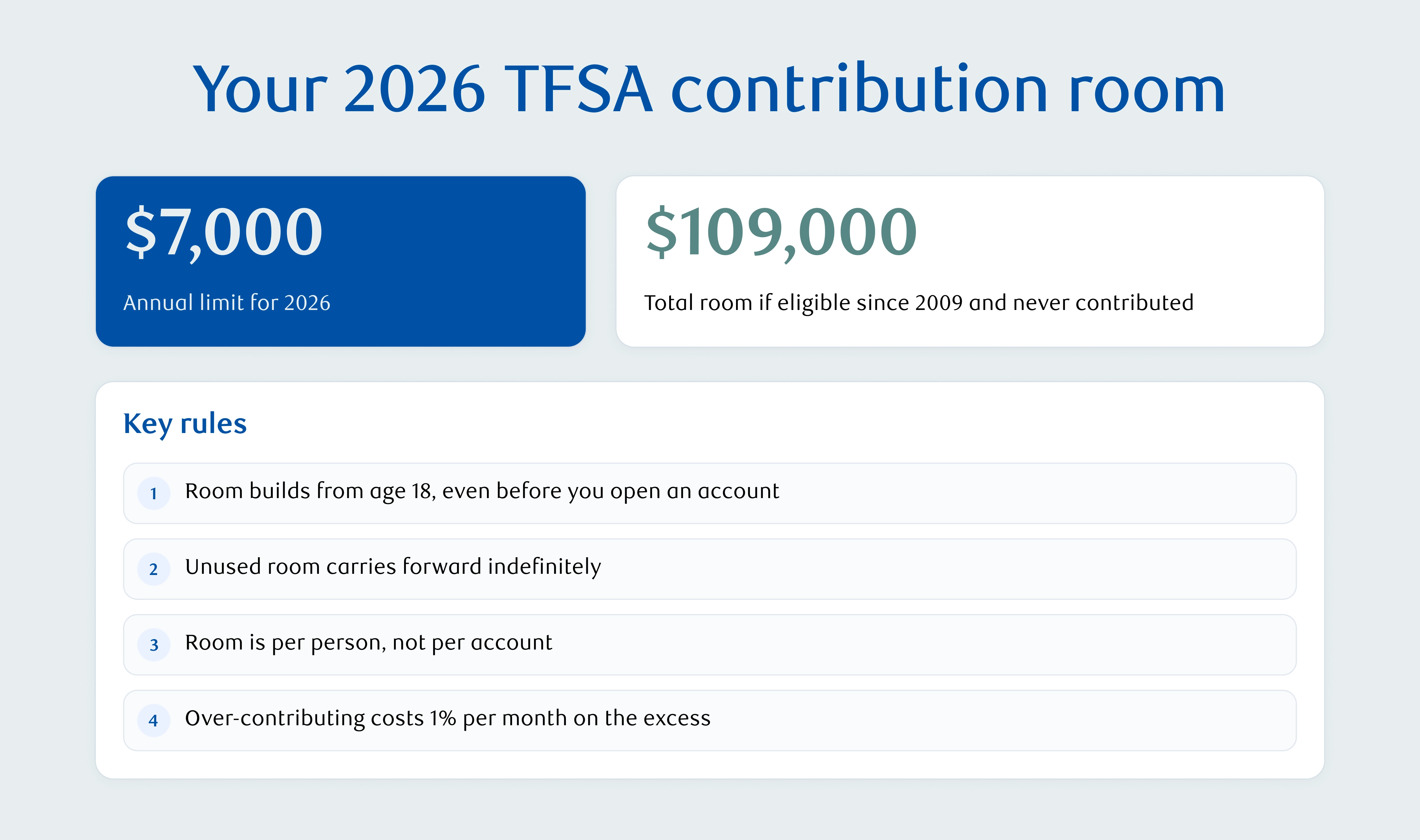
Since the TFSA is indexed to inflation (and rounded to the nearest $500), you’ll see that the annual limit increases every few years.
Note that the 2015 limit of $10,000 was a one-year change which also set aside inflation indexing for the year. The following year, the limit returned to $5,500 and indexing resumed. The CRA confirms each year's limit in the fall of the preceding year.
There are two important adjustments that change your personal total contribution room:
- You turned 18 after 2009. Room starts accumulating the year you turn 18, not 2009. Someone who turned 18 in 2020 has $45,500 of room in 2026: $6,000 (2020) + $6,000 (2021) + $6,000 (2022) + $6,500 (2023) + $7,000 (2024) + $7,000 (2025) + $7,000 (2026).
- You became a resident after 2009. Room accumulates only for the years you were a Canadian resident. A newcomer who became a resident in 2023 has $27,500 of room in 2026: $6,500 + $7,000 + $7,000 + $7,000.
How do I withdraw money from my TFSA?
TFSA withdrawals are tax-free, unlimited and available at any time for any reason. There's no penalty, no minimum holding period and no requirement to explain what the money is for.
The amount you withdraw is added back to your contribution room, but only on January 1 of the following calendar year, not in the year you make the withdrawal.
That timing is where a lot of mistakes with using a TFSA happen.
Re-contributing a withdrawn amount in the same calendar year doesn't draw on restored room, because the room hasn't been restored yet. It counts as a fresh contribution against whatever room you have left.
Say you withdraw $5,000 in June 2026, having already maxed out your room for the year.
Re-contributing that $5,000 in November 2026 puts you $5,000 over your limit, and the one per cent monthly tax applies, which works out to $50 per month for as long as the excess sits in the account.
If you were to wait until January 1, 2027, the $5,000 will have been added back, and you can re-contribute it with no penalty.
Withdrawals don't have to be cash, meaning you don't have to sell your holdings to take money out. Transferring an investment out of the account "in kind" is also a withdrawal, and the amount counts as the fair market value of the investment on the day it's transferred.
The reverse works too, though with a tax consequence worth knowing about.
Contributing an investment in kind from a non-registered account counts as a deemed disposition, meaning that for tax purposes you're treated as having sold it at fair market value that day, and any capital gain is taxable in that year.
Moving a TFSA between institutions
A direct transfer between two of your own TFSAs doesn’t count as a withdrawal and doesn't touch your contribution room. The key is that the funds must go directly from one TFSA to another, whether at the same or different institutions. They must never leave a TFSA to go into another type of account first. Use the receiving institution's transfer forms (many of which can be completed online) to set this up.
Withdrawing the money yourself to a bank account or non-registered account, then depositing it into a different TFSA, is treated as a withdrawal followed by a new contribution, which can put you over your limit.
What happens to your TFSA when you die?
A TFSA can also pass to someone else, though who you name to receive it changes how it's taxed.
A spouse or common-law partner can be named successor holder (except in Quebec), which keeps the account's tax-free status and rolls it into the survivor's own TFSA without using any of their contribution room.
Anyone can be named beneficiary instead, in which case the account value passes tax-free but the account loses its sheltered status, so any later growth becomes taxable and the amount doesn't add to the recipient's own room.
If I withdraw from my TFSA, can I re-contribute?
Yes, but not right away. The withdrawn amount returns to your contribution room on January 1 of the following year.
Is TFSA tax deductible?
Contributions to a TFSA are not tax-deductible. Unlike RRSP contributions, they don't reduce your taxable income for the year.
However, investment growth inside a TFSA, including interest, dividends and capital gains, is generally tax-free.
Withdrawals from a TFSA don’t count as income, and they don’t affect income-tested benefits like OAS, GIS or the Canada Child Benefit.
There are exceptions where tax can still apply, however:
- U.S. dividends: The IRS applies a 30 per cent withholding tax on U.S.-source dividends paid into a TFSA, reduced to 15 per cent if you've filed the appropriate W-8BEN form with your brokerage. Other countries may also withhold tax on income from their securities. (There is an exemption for RRSPs under the Canada-U.S. tax treaty, but it does not apply to TFSAs.)
- Day trading or business activity: If the CRA determines you're carrying on a business inside your TFSA (frequent trading, high turnover, ), the gains can be taxed as business income.
- Non-qualified investments: If your TFSA holds investments that are not qualified investments under the Income Tax Act, you may be subject to tax on those investments.
What happens if I over-contribute to my TFSA?
Unlike the RRSP, the TFSA has no $2,000 over-contribution buffer. Every dollar you contribute above your limit is taxed at one per cent per month for as long as the excess remains in the account.
Say you contribute $9,000 to the TFSA in 2026, but your available room is only $7,000. If the $2,000 excess sits in the account for five months, then the penalty is $2,000 × 1% × 5 = $100.
Try to avoid contributing more than your available room, but mistakes can happen, usually because of one of these reasons:
- Re-contributing a withdrawal in the same calendar year. The room isn't restored until January 1, so the re-contribution counts as new.
- Holding TFSAs at more than one institution. Each institution tracks only the account it holds. The combined total is yours to monitor.
- Relying solely on the CRA My Account figure. Institutions report to the CRA by the end of February, and the CRA usually updates its figures in the spring, based on the previous calendar year. The number won't reflect recent activity, so it can be months out of date.
If you do accidentally contribute more than your available room, withdrawing the excess stops the one per cent tax from accruing in subsequent months, though it generally does not eliminate the tax for the month in which the withdrawal is made.
You'll also have to file Form RC243 Tax-Free Savings Account (TFSA) Return, by June 30 of the following year to report the over-contribution and pay the tax owed.
There's also a heavier penalty for deliberate over-contributions.
If the CRA determines you knowingly contributed above your limit, any income or capital gains earned on the excess can be subject to a 100 per cent advantage tax, meaning the entire gain goes to the CRA. That applies in addition to the one per cent monthly tax, not instead of it.
TFSA contributions for non-residents
A non-resident of Canada with a valid SIN can open a TFSA, but contributing is a different matter. Any contribution made while you're a non-resident is subject to a tax of one per cent per month for as long as it stays in the account.
Full calendar years spent as a non-resident don't add contribution room either, though existing room carries forward and becomes usable again if you return.
TFSA vs RRSP
Both the TFSA and Registered Retirement Savings Plan (RRSP) are registered accounts and both shelter investment growth from tax, but they work differently.
The main difference is that the TFSA gives you the tax break at withdrawal, while the RRSP gives it to you at contribution.
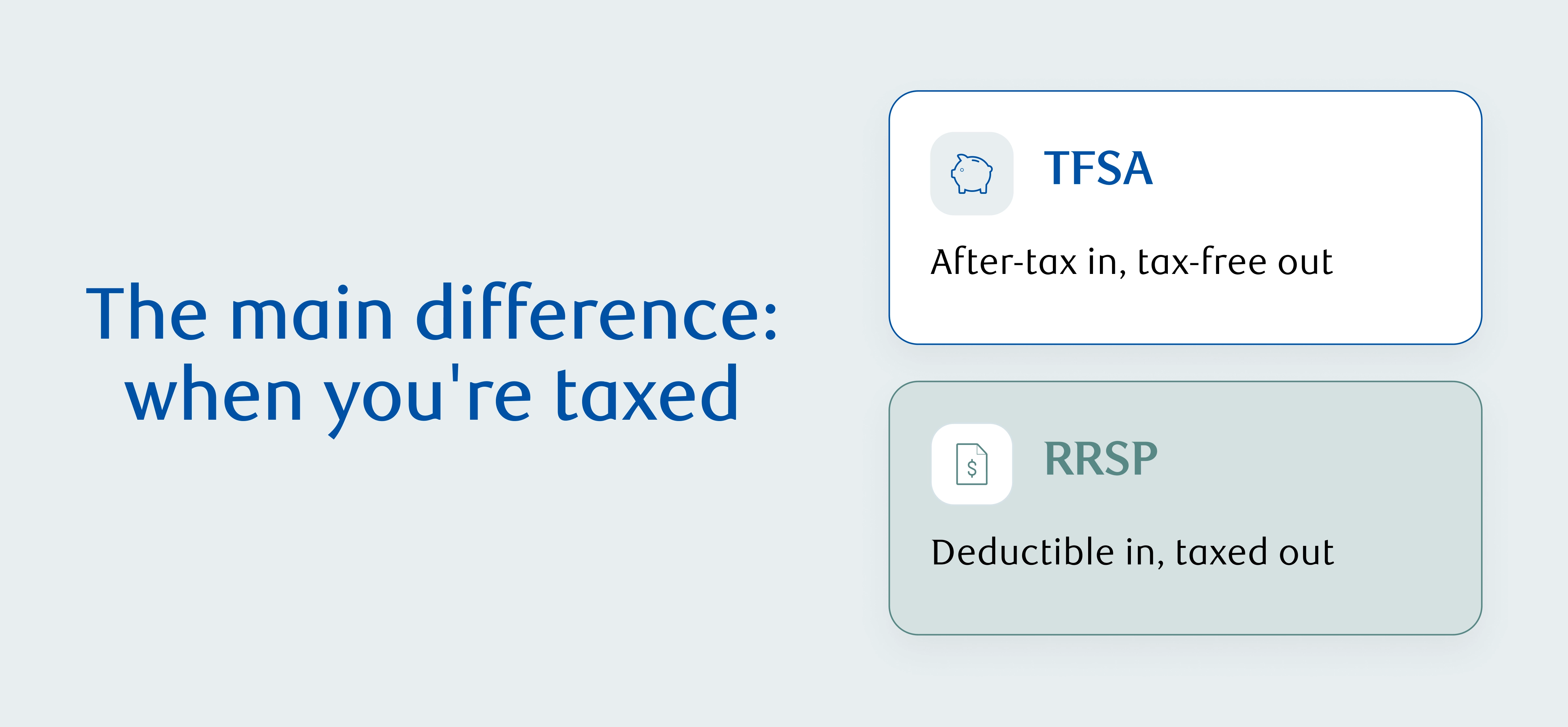
| questions | TFSA | RRSP |
|---|---|---|
| Who qualifies | Canadian residents 18 or older with a valid SIN | Canadian residents with earned income who file a tax return, any age |
| Are contributions deductible? | No. Made with after-tax dollars | Yes. Contributions reduce your taxable income |
| How is growth taxed? | Tax-free | Tax-deferred |
| How are withdrawals taxed? | Tax-free, and not counted as income | Taxed as income in the year you withdraw |
| 2026 contribution limit | $7,000 | 18 per cent of prior-year earned income, up to the annual maximum, minus any pension adjustment |
| Is the unused room carried forward? | Yes | Yes |
| Is the withdrawn room restored? | Yes, on January 1 of the following year | No, except under the Home Buyers' Plan or Lifelong Learning Plan |
| Contribution deadline | December 31 | 60 days after year end |
| Account deadline | None. The account can stay open for life | Must be closed or converted by December 31 of the year you turn 71 |
| Effect on income-tested benefits | None | Withdrawals can reduce benefits such as OAS and GIS |
Glossary
- TFSA (Tax-Free Savings Account) – A registered account where investment growth and withdrawals are generally tax-free and don't count as income.
- Contribution room – The total amount you're allowed to contribute to your TFSA at any given time, based on annual limits plus any carried-forward or restored room.
- In-kind contribution/withdrawal – Moving an investment into or out of a TFSA without selling it first, valued at its fair market value on the transfer date.
- Deemed disposition – A tax rule that treats an in-kind contribution from a non-registered account as if you sold the investment at fair market value, triggering any capital gains tax owed.
- Successor holder – A spouse or common-law partner validly designated to inherit a TFSA, who becomes the new holder immediately on death and may arrange a direct transfer of TFSA assets to another TFSA of their own without using contribution room. Note that Quebec does not generally recognize successor holder designations for TFSAs.
- Beneficiary – Anyone (not just a spouse) named to receive TFSA funds on death; the money passes tax-free but the account loses its TFSA status, so future growth becomes taxable (subject to certain exceptions).
- Over-contribution tax – A one per cent monthly tax the CRA charges on any amount you contribute above your available TFSA room, for as long as the excess remains in the account.
- Advantage tax – A 100 per cent tax the CRA can apply to income or gains earned on a deliberate over-contribution, on top of the standard one per cent monthly tax.
Next steps: Open and contribute to a TFSA with RBC Direct Investing
TFSA rules take a bit of work to learn, but once they're clear, the account itself is straightforward.
The practical starting point is similar for most people: knowing your available contribution room can help you plan how to use it.
Check your room in CRA My Account, keeping in mind it may lag your recent activity by a few months. From there, a TFSA with RBC Direct Investing Go Smart is one option for putting that room to work, whether you're opening your first account or making a contribution to one you already hold.
Ready to start?
You now have the foundation you need to consider investing. Whether you want the simplicity of GoSmart, the hands-on control of self-directed investing you can get started as soon as you’re ready.
Ideal for New Investors
Ideal for New Investors


Ideal for Established Investors
Ideal for Established Investors
Open all other RBC Direct Investing Accounts
Open all other RBC Direct Investing Accounts
Open an AccountVisit Investing Academy to learn more about Investing